drinks & cocktails
Restaurant Review – Vert’in, Cabanas
The newly opened Vert’in restaurant and bar makes an excellent addition to the foodie scene in Cabanas in the Eastern Algarve. Tucked away on the sun-drenched courtyard of the Pomar housing development, Vert’in offers fabulous French/Portuguese food in a relaxing setting. Diners can choose to eat in the coolness of the crisp white and green interior or enjoy the weather with an outside table.
It being the first properly sunny day of the year, we choose to sit outside. Although we arrived a little late for a lunch sitting, the service was swift and attentive and two tables were quickly pulled together to seat our party of six.
The menu at Vert’in is impressive. As well as a long list of staple Portuguese main courses (including steaks, pork and a range of seafood dishes), the French owners had thought to include savoury and sweet crepes (to my delight), as well as a wide range of vegetarian options – something quite unusual for an Algarve restaurant.
Between the six of us we ordered steak (rare), black pork, Portuguese prawn curry, a cheeseburger and two savoury crepes (we went for warm goat’s cheese, walnut and honey), plus a couple of side dishes. Without exception the food was excellent. The steak was fabulously rare, the curry creamy and full of flavour and the cheeseburger and chips kept my nephew very happy. The black pork was delicious and it was nice to see that our waiter checked when we ordered it that we knew what to expect (as it was a very fatty cut, cooked slightly pink).
For me, the stand-out item was the crepe. With the perfect balance of goat’s cheese, nuts and honey it was an absolute delight. It’s going to be difficult for me to try anything else on the menu next time we go there, now that I know how great the crepes are!
Portions were generous enough that we had no room for dessert, but we returned a couple of hours later to try out a couple of items from the extensive dessert menu. The tarte tatin and gooey chocolate pudding were very well received and the desserts were good enough that my nephew ended up having two.
The price for our main meal was reasonable (€100 including tip for six of us, although that didn’t include our desserts).
A good range of cocktails is also available from Vert’in and the drinks are clearly made with as much pride as the food. They can make for an expensive night out, but sipping one slowly after dinner won’t break the bank. The kiwi margarita is particularly recommended!
It’s unusual for me to write a restaurant review that is so complementary, but we really did struggle to fault Vert’in. The food, drinks and service were all very good. The only tiny error was that one member of our party received a milky coffee after her meal instead of the black coffee she had ordered. Even then, it was replaced without hesitation and with an apology from three different members of staff.
Despite being the newest restaurant in Cabanas, Vert’in has already made its mark. We will definitely be back – and soon!
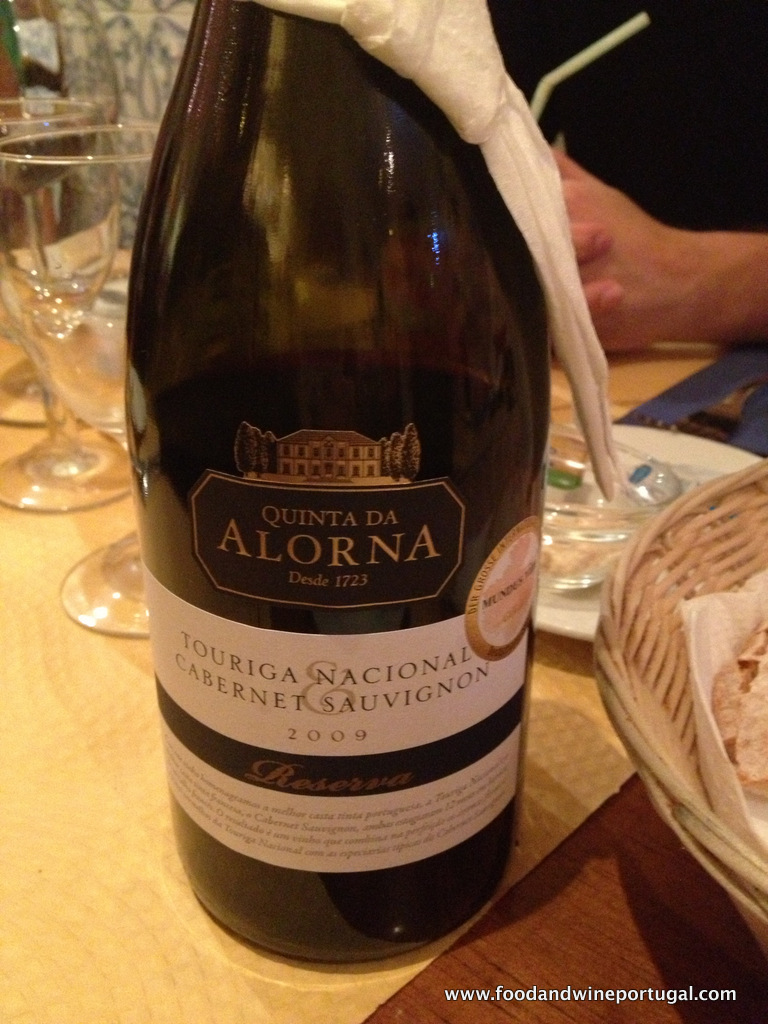
Red Wine Review – Quinta da Alorna 2009
We selected this red wine based on how good the Quinta da Alorna Reserva 2009 had been. The Reserva had won the gold Mundus Vini medal and was delicious, so we were excited to find the regular Quinta da Alorna 2009 red had not only scooped the gold Mundus Vini 2011 medal, but also the gold Concurso Mundial de Bruxelas 2012 medal.
Our expectations were not disappointed. This is a lovely, deep ruby red wine, which is full of big fruity flavours. It manages to be a robust mouthful, yet delightfully smooth at the same time. The bottle recommended it as an accompaniment to white meats, cheese and pasta, but personally I think it would stand up well to red meat too.
At half the price of the Reserva, this is a really good option for a low-cost red and it’s one that I’ll be buying next time we have guests for dinner.
Price: €2.98 in Jumbo
Port Wine
Portugal is famous across the world for its production of port wine, which is made in the vineyards of the country’s Douro region. Within Europe, only port from Portugal can be sold as port or Porto, though the restriction does not apply to the rest of the world.
Port is a fortified red wine which is traditionally drunk after dinner to accompany dessert. Restaurants in Portugal often offer a glass of port ‘on the house’ to diners at the end of a long meal.
Port comes in several varieties, with the most well-known being tawny port, ruby port and white port. As with any drink, prices and quality can vary, but the bottles I’ve tried (and I’ve tried a fair few since moving here) have all been good, even at the lower end of the price range.
Outside of Portugal, tawny and ruby port are the most popular choices, but within Portugal white port has a strong following and we’ve done our best to introduce many of our guests to it over the years. It’s perfect served chilled as an aperitif.
In 2008 a new contender entered the arena, with the launch of rose port. Although it hasn’t taken off in a big way yet, this lighter version of ruby port (both of which are made with red grapes) is delightfully refreshing and I would encourage anyone visiting Portugal to give it a try. Served with soda water and fresh raspberries, it makes a lovely summer alternative to Pimm’s.
An extensive range of vintage port (made from grapes of a declared vintage year) and crusted port (blended from several vintages) is available for those who want to truly taste the variety of port on offer.
Port makes a lovely present and can be picked up in any supermarket or wine shop in Portugal. Presentation boxes and prettily shaped bottles are readily available, so next time you are in Portugal, why not treat someone (or yourself!) to a bottle.
If you want to discover more about the wonderful range of drinks we have sampled in Portugal, why not check out our book:
Moving to Portugal: How a young couple started a new life in the sun – and how you could do the same
Image credit: Fotopedia
Making Lemonade with Real Lemons
They say that when life gives you lemons, make lemonade. This week my mother-in-law provided me with a giant bag full of lemons plucked from the tree outside her house, so I set about making lemonade with real lemons.
This is a really quick and easy recipe, so it’s great if friends have just popped round unexpectedly, and went down very well during our Portuguese lesson yesterday! It’s also very refreshing – perfect as Portugal warms up for another hot summer season.
Lemonade Ingredients
250 ml water
1 cup sugar
250 ml lemon juice
1 litre water (additional)
1. Put 250 ml water in a pan with the sugar. Heat gently and stir frequently until the sugar has dissolved.
2. Turn off the heat, then stir in the lemon juice.
3. Add the litre of water to dilute the mixture and stir thoroughly.
4. Serve in large pitchers full of ice, with a few lemon slices thrown in if you wish.
I never realised quite how easy it was to make lemonade with real lemons, and will be doing so again.
For anyone reading this post wishing they lived somewhere where life’s problems include having too many lemons to know what to do with, I highly recommend this book:
Driving Over Lemons: An Optimist in Andalucia (The Lemons Trilogy)
“Portuguese?” Lemongrass Tea
Lemongrass can be really tricky to get hold of in the Algarve, so we were delighted to find some in our local supermarket recently, and looked forward to making a Thai dish with it.
To our shame, we found it a week or so later looking a little past its best, when we had already planned our meals for the week. My wife was determined not to throw it away after we had been so delighted to find it. She had heard that the usual use for lemongrass in Portugal was to make tea with it, so that is what she did. Over to her.
This is really the simplest recipe ever. It makes two cups of delicious, fragrant lemongrass tea. As lemongrass has a wide range of health benefits (from lowering cholesterol to preventing acne), it’s good for you too.
Ingredients:
1 stick of lemongrass
Boiling water
1. Chop the lemongrass into 1 cm chunks in a small jug.
2. Pour enough boiling water into the jug for two cups of tea.
3. Allow to steep for 3-5 minutes, to taste.
4. Pour into tea cups, straining to remove the chunks of lemongrass if you prefer.
You can vary the recipe by adding mint leaves or other infusions.
Portuguese Liqueurs – A Beginners Guide
There are some pretty fabulous liqueurs on offer in Portugal. Perfect for enjoying after a meal, or indeed just for the sake of it!
Friendly restaurateurs sometimes hand out a free glass of something Portuguese after a meal, but it is usually port or aguardente (Portuguese “fire water.”) You have to hunt down or request some of the other treats. As far as I have seen, even here in the touristy Algarve, not a lot is done to publicise some of these enjoyable drinks.
Amendoa is a sweet almond liqueur, rather like the Italian amaretto but lighter and lower in alcohol. Great with a dessert, it is perfect straight from the bottle but, for me, is especially good poured over ice and lemon. When we celebrated a recent birthday in the Quatro Aguas restaurant in Tavira, we were given a cocktail which included amendoa shaken with fresh lemon juice which was rather special—the sweet and sour blending together wonderfully.
Ginja (Ginjinha) is a brandy-based cherry liqueur, sometimes served complete with booze soaked sour cherries which have been steadily increasing in alcohol content whilst in the
bottle. Great for shots, ginginha is best enjoyed as the sun goes down in Lisbon, where it can be purchased from tiny bars lined with Portuguese tiles, barely big enough to accommodate 3 people. The drink is served is small paper cups and enjoyed amongst the crowds outside, consisting of a mixture of tourists, locals and resident nutcases.
Licor Beirao is quite a unique herby-tasting little number with a slight note of aniseed. However, it is light and fresh and nothing like a Greek ouzo taste.
Medronho is a very potent spirit brewed from the arbutus (wild strawberry) tree. Medronho can be fiercely potent and is available in variations ranging from unlabelled homebrew bottles, moonshine style, to connoisseur tipples at scarily high-prices. If you have the opportunity to try it, definitely have a go, but leave the car keys at home! I have been told that Monchique, in the west of the Algarve is THE place to go for medronho, but I have yet to buy any from there – watch this space!
This is a starting point but there are plenty more Portuguese liqueurs to choose from. Gourmet food shops around the Algarve are a good place to start. They often stock small-batches of liqueurs from local producers, including some made from local oranges.
The best part? These drinks are super-cheap. A bottle of amendoa in the supermarket comes in at less than €4 euros – so there’s no reason not to have a whole range in the drinks cabinet. Saude!
Cocktails for Summer….and a Salad
Readers of the blog may be aware that I also write articles for Suite 101, and I have recently added recipes for some cocktails, perfect for this warm summer – including the classic Brazillian caipirinha. There is also a lovely salad to use up all those tasty left-overs from Summer BBQs.
Follow these links to view my recipes:
How to make Pimms No.1 – the classic English summer cocktail.
Bloody Mary – Portuguese Style
We usually fly to and from Portugal on budget airlines, so when, a couple of months ago we found ourselves flying “full service,” with British Airways, it was a pleasant surprise when the trolley of free drinks came down the plane.
I spotted the little brown bottle of Worcestershire sauce and couldn’t believe that for several years I had somehow forgotten how much I enjoyed a good bloody mary. I ordered one on the plane, but there was no Tabasco sauce available, so the drink I was given wasn’t quite up to scratch.
Back in Portugal, I got to wondering whether a bloody mary would be quite as good with local ingredients. Although Worcestershire sauce is available here, it is imported and therefore rather expensive, and the local alternative is a lighter coloured sauce called “Molho Ingles.” Tabasco is also hard to come by, but hot piri piri sauce is everywhere. It was time for an experiment.
I mixed a glass of ice, a good dollop of Absolut vodka, tomato juice, a wedge of lemon, and topped it off with a layer of Molho Ingles, ten drips of hot piri piri sauce and a grinding of pepper. I’ve never really been a fan of celery near my bloody mary so I left that out.
The verdict: yes, it works, and in all honesty using the cheaper local ingredients makes no difference that I can notice. When we next have friends staying I look forward to serving up a hangover-destroying bloody mary breakfast!
I have also posted a Bloody Mary recipe over at Suite 101. Click here to visit.